Are WPC wall panels soundproof?
Fluted WPC panels can make a room look more acoustically considered, but grooves do not by themselves prove that speech will be quieter or that sound will not pass through a wall. Buyers need to define whether the goal is less echo inside a room or better separation between rooms.
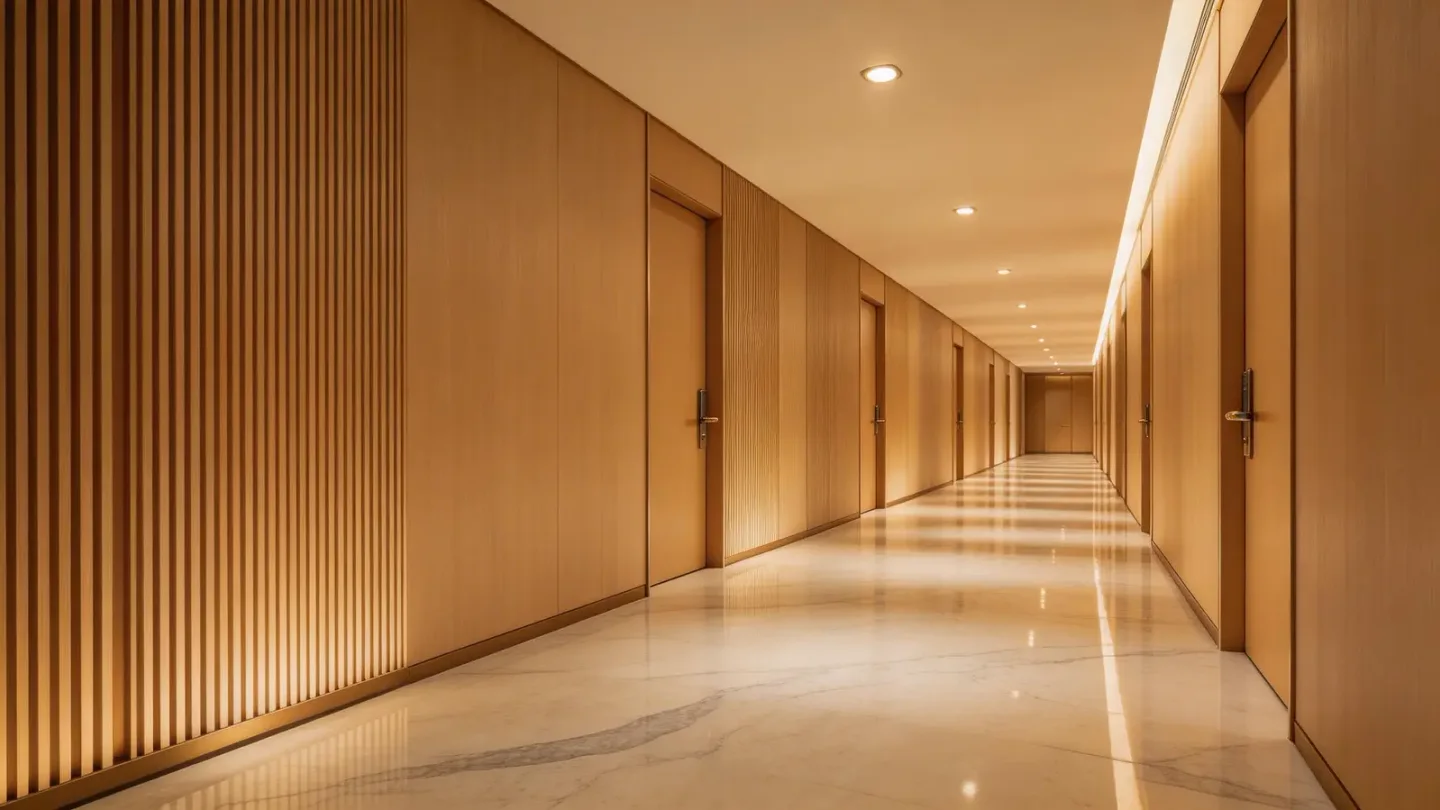
Do not call a decorative WPC panel soundproof without evidence. Ask for an acoustic report on the exact panel and mounting, and distinguish sound absorption from sound insulation when writing a project specification.
Ask which acoustic problem exists
An echoing lobby may need absorptive surfaces; a noisy hotel guest room may need a better partition, door, seal or service-penetration detail. Decorative cladding alone is unlikely to solve both. Write down the existing wall construction, room volume, noise source and target before choosing a surface. This prevents the sales team from promising a measurable improvement from a product that was never tested for the relevant metric.
Read the measurement setup
ISO 354 describes measuring sound absorption in a reverberation room. A report should state specimen area, mounting, backing, air gap and the measured frequency-dependent results. A panel mounted directly to a hard wall may behave differently from the same face over absorptive backing. Absorption data are useful for room-acoustic design, but they do not establish sound insulation through an entire partition.
Specify the complete system
If the design wants a fluted look and acoustic benefit, ask whether an absorptive backing or perforated system is offered and test it as supplied. Detail edges, doors and penetrations with the acoustic consultant. If no report exists, describe the panel as decorative rather than “soundproof.” A mock-up can help judge visual and subjective room quality, but it does not replace laboratory or project measurements.
Illustrative buyer situation
A hotel designer proposes fluted WPC in a corridor after guests complain about noise between rooms. The corridor finish may change the room sound, but the complaint could involve doors or partitions. Before buying cladding for the whole floor, the team should ask an acoustician whether the target is absorption in the corridor or transmission between rooms. A tested backing assembly might help the former; it cannot be assumed to solve the latter without appropriate evidence.
Buyer checklist before ordering
- Define absorption versus room-to-room insulation
- Exact panel and mounting in the acoustic report
- Frequency results and test method
- Complete wall, door and penetration design
Save the approved sample, product code and document references with the purchase order. A catalog helps shortlist a finish but does not establish the final specification, local acceptance, price or delivery terms.
Common buyer questions
Do fluted grooves automatically absorb sound?
No. Shape alone does not establish measured acoustic performance.
Is an NRC value the same as soundproofing?
No. It relates to absorption, not necessarily sound transmission through a wall.
Can a project use WPC decor with acoustic backing?
Possibly, but the complete assembly should be designed and evidenced for the target.
Compare the range and request the exact specification
Browse the relevant product catalog (PDF, English), then tell Luvie the destination market, room or project use, approximate quantity and the finish you want to sample. We can discuss which current SKU and documents are available; do not assume a catalog image establishes certification or a guaranteed lead time.
Turn the question into a verifiable product brief.
Send the application and target market so the conversation starts with a specific product, sample and evidence request.
Ask Luvie about this use