Luvie Industry · 2026-11-06
SPC Bedroom Floors in Peru: Ask the Acoustic Questions
For an apartment bedroom in Peru, the sound of footsteps can matter as much as the floor colour. However, asking whether SPC flooring is quiet does not define a testable requirement. A buyer should separate sound within the room from transmission to another apartment and identify the building assembly before comparing claims.
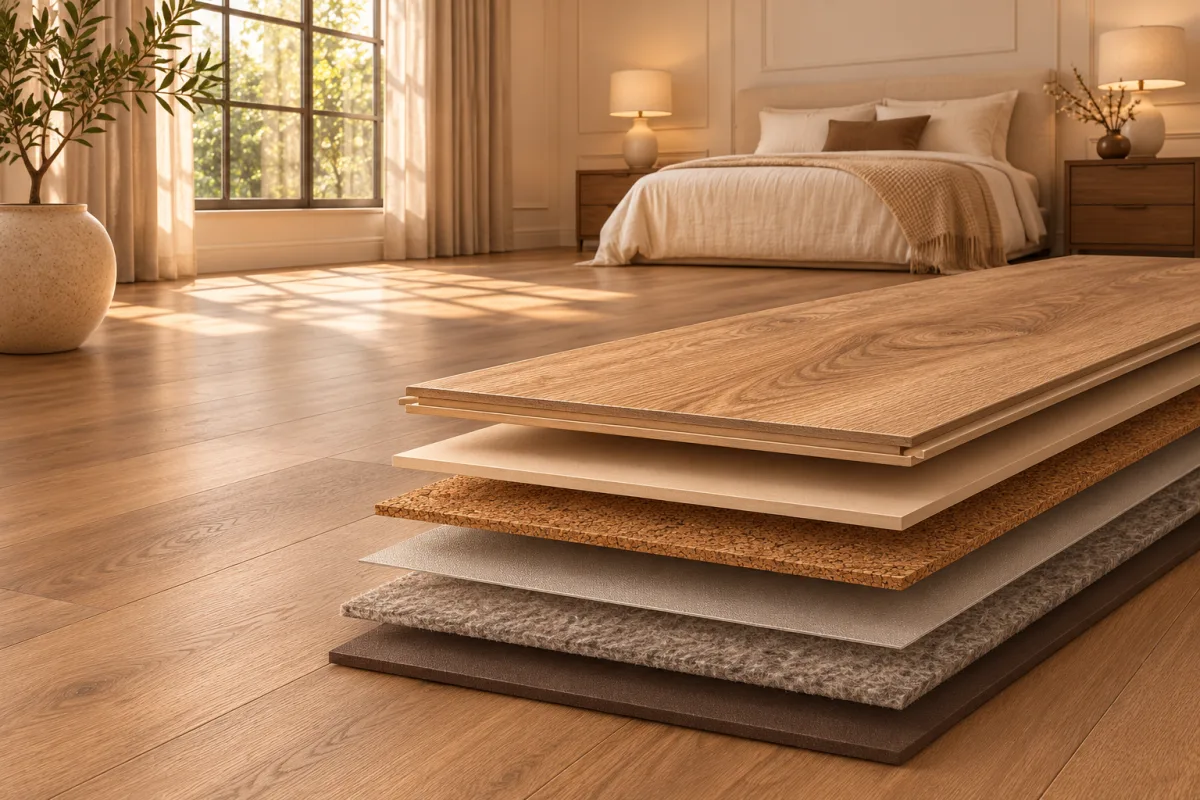
Request evidence for the relevant sound question and complete floor assembly. Do not transfer a result from a different slab, ceiling or underlay to your project, and do not add an extra layer without installation approval.
Define whose experience is being assessed
Ask whether the concern is the sound heard by someone walking in the bedroom, impact transmitted downstairs or airborne noise between rooms. These are different questions and should not be answered with one marketing adjective. Describe the existing floor construction and any ceiling below as far as the project team can verify. An apartment association or building manager may have requirements that the buyer must obtain separately. Do not assume a supplier’s generic acoustic claim is a substitute for the project’s local requirements or an acoustician’s assessment.
Read the assembly behind a quoted result
When a report is offered, identify the flooring product, attached backing, additional underlay, supporting construction and test method. Ask the supplier to explain what the result does and does not cover. A value measured for a different assembly cannot simply be printed on your project specification. ISO quality-management-system certification is a separate issue; it does not establish an acoustic result. Keep the report and its limitations with the quotation so the sales discussion remains connected to evidence rather than an isolated number on a brochure.
Coordinate underlay with the flooring instructions
A softer or thicker additional layer is not automatically a better choice for a click floor. Request the exact product’s installation guidance and written approval for the proposed build-up. Have the installer assess the existing substrate and interfaces. Do not prescribe a generic underlay thickness or promise that an added mat will solve neighbour complaints. The useful purchase decision is an approved assembly with defined responsibilities, not a collection of individually appealing components whose compatibility has never been checked.
Use a room trial for expectations, not certification
A limited trial may help the buyer understand appearance and the sound perceived in that particular room. Record the trial arrangement and explain that it is not a laboratory test or a guarantee for every apartment. Include trims, door clearances and maintenance expectations in the review. Before ordering, identify any acoustic question still requiring professional advice. This gives the Peruvian buyer a sensible route to a decision without turning an uncertain performance claim into a promise that the installed bedroom will be soundproof.
Before you request a quotation
- Separate room sound from sound transmitted to neighbours.
- Check the entire tested assembly and method.
- Obtain approval for the proposed underlay combination.
- Record unresolved acoustic requirements before ordering.
Frequently asked questions
Does an attached pad prove the floor is soundproof?
No. Acoustic performance depends on the relevant complete assembly and the type of sound being considered.
Can I add any soft underlay for more comfort?
No. Follow the flooring instructions and obtain approval for the intended combination.
Next step
Contact globalsales@luvieindustry.com or WhatsApp +86 19005833027 with your Peru apartment floor build-up and the acoustic requirement you need to review. Ask Luvie which product-specific documents are available; specialist assessment may still be needed.