Luvie Industry · 2026-10-06
Can decorative wall panels hide condensation in a Gulf hotel?
A hotel lobby can look dry while warm humid outdoor air moves toward chilled surfaces inside its wall. The buyer’s question is not merely whether the decorative panel can be wiped clean; it is whether the complete wall assembly controls air and moisture at that location.
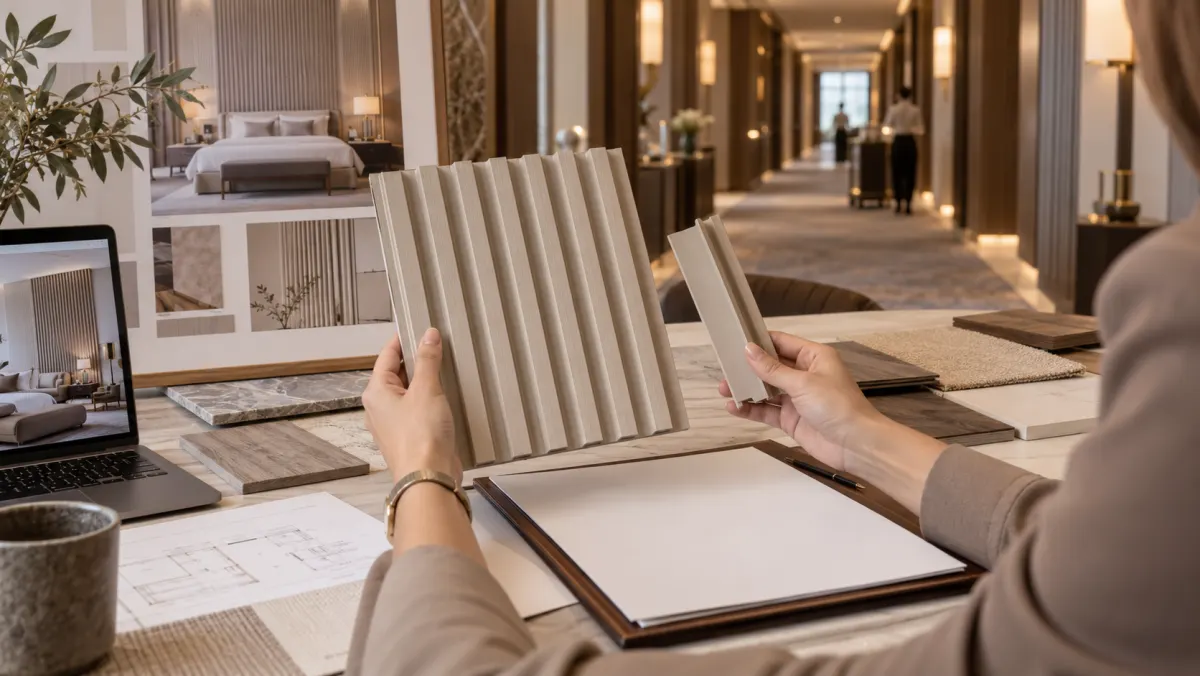
Yes, concealed moisture is possible when humid air reaches a cooled wall cavity or substrate. Assess the building envelope and HVAC design before selecting or fixing the decorative finish.
Map the exposure before selecting a finish
Record whether the wall is an exterior perimeter wall, a cooled internal partition, a bathroom-adjacent wall or a reception feature. Note AC operation, doors that open frequently, known leaks and any staining or odor. The same panel can face different risks in a conditioned lobby and a sheltered corridor. Neither PVC nor WPC is a universal solution to moisture behind a finish.
Ask where humid air can meet a cold surface
The U.S. EPA explains that in hot, humid climates even slight negative pressure can pull outdoor moisture into chilled wall cavities. This is general building-science guidance, not a test of Luvie panels. Ask the architect or mechanical engineer to review the air barrier, pressure balance, insulation and condensation risk. A solid decorative face should never be used to cover an unexplained damp patch.
Approve the wall assembly, not only the panel face
Request the exact SKU and its approved interior use, then review substrate dryness, fixing, joints, corners, penetrations and access for maintenance. Check whether the proposed adhesive or mechanical fixing is compatible with the substrate and the room’s cleaning regime. If the wall requires drying to the interior, adding a low-permeability finish without a design review may change its behavior. The designer must determine the appropriate assembly.
Build a sample panel under realistic conditions
A physical mock-up should include a corner, a joint and at least one service penetration, not just a flat center piece. Observe it under the intended lighting and air-conditioning cycle. Specify who inspects the backing before enclosure and how any leak will be investigated later. Confirm fire and emissions evidence separately for the exact panel and installation if the hotel authority requires it.
Illustrative hotel decision
Imagine a feature wall beside a revolving entrance in a humid coastal city. The proposed fluted surface looks suitable, but staff report occasional odor near the wall after busy evenings. The correct next step is to investigate air leakage, HVAC pressure and substrate condition, not to sell a more water-resistant-looking face. Once the wall is sound, compare samples and finish details for the design brief.
Next step
Send the room type, wall position, climate-control conditions and selected sample to discuss a product-specific specification route.
View the relevant product catalog (PDF) · Explore the product family