Luvie Industry · 2026-10-25
WPC wall panels for Saudi hotel corridors: separate decoration from impact protection
A fluted wall can look convincing in a hotel rendering while leaving unanswered questions about luggage, housekeeping carts and exposed corners. For a Saudi hotel corridor, buying an attractive WPC finish is not the same decision as buying an impact-protection system. This guide helps the purchaser separate those scopes before comparing quotations. It does not claim that Luvie panels have a tested impact rating or that every corridor needs the same protection.
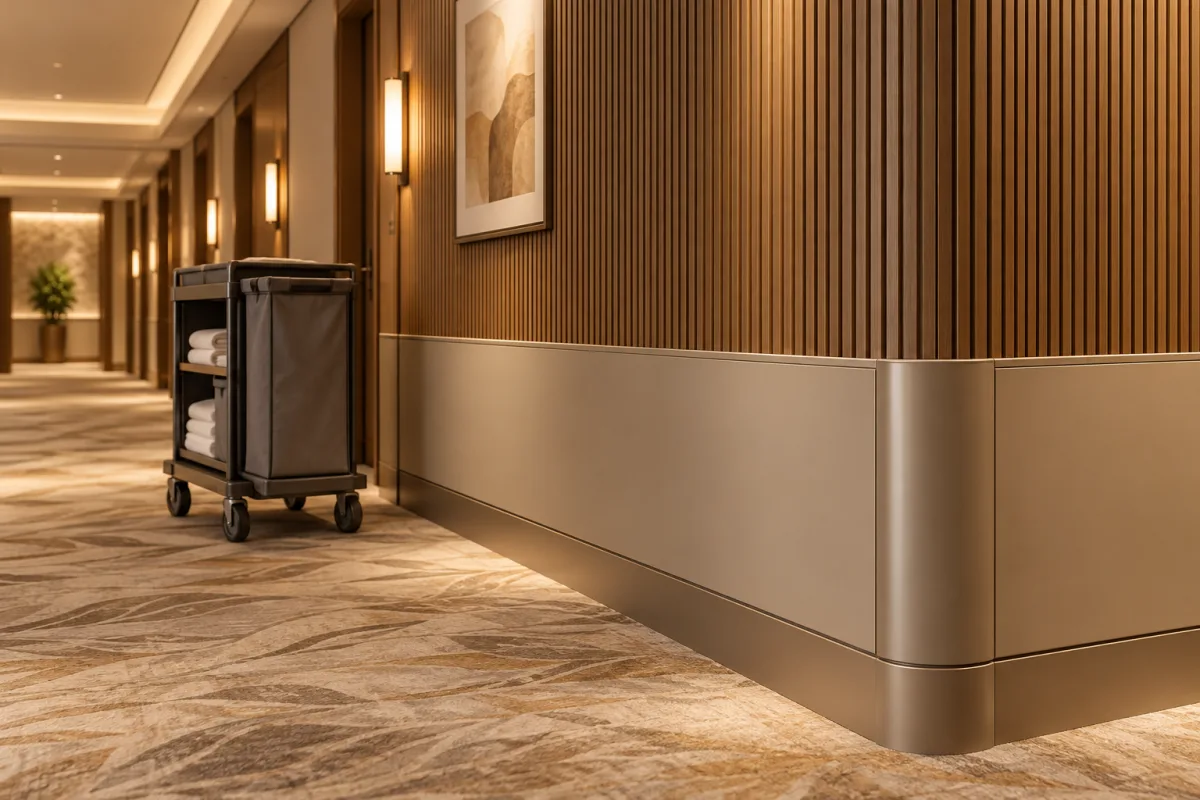
Map the actual contact risks, define the protection requirement separately, and ask for evidence for the proposed assembly. Where separate guards are needed, coordinate their support, edges, cleaning and replacement with the decorative wall design.
Walk the route with the operations team
Review lift exits, service-room doors, turning points and narrow sections using the actual trolley and luggage arrangements. Record what may touch the wall and where, rather than selecting a guard height from a generic photograph. Ask housekeeping and maintenance staff which surfaces must be reachable for cleaning. Keep this operational review distinct from fire, accessibility and other project approvals; an impact solution must not be assumed to satisfy those separate requirements.
Ask what the quotation is designed to protect
List decorative WPC finish, corner guards, protective rails and any backing as separate items. Inpro markets dedicated commercial wall-protection products; this illustrates a separate specification category, not proof that a decorative panel provides equivalent protection. Ask the proposed supplier for relevant evidence, installation conditions and limitations. A scratch-resistance statement does not automatically address a trolley collision. If performance evidence is unavailable, mark that requirement unresolved instead of describing the finish as heavy-duty.
Coordinate the junction, not only the colour
Where a guard meets a fluted panel, review projection, exposed edges, fixing access and the backing required by the selected system. Do not assume the decorative face is an adequate anchor. Have the designer and installer agree details that retain required clearances and do not create an uncleanable ledge. Check compatible cleaning instructions for both materials. Include an actual corner and a representative transition in the approval sample when those interfaces affect the project.
Compare repair scope and handover information
Ask how a damaged guard or panel would be replaced and what adjacent material must be disturbed. Identify spare references and approved cleaning methods in the handover pack. Compare quotes for the complete assembly and installation responsibilities, not just the decorative square-metre rate. Record unresolved items before procurement approval. For a phased Riyadh or Jeddah fit-out, keep revisions linked to the relevant corridor so a later phase does not receive an unapproved substitution.
Before you request a quotation
- Traffic and contact-risk review
- Separate decorative and protective scopes
- Evidence and backing details for the selected system
- Replacement references and cleaning handover
Frequently asked questions
Does a thick WPC panel prove trolley-impact resistance?
No. Thickness alone does not establish the performance of the installed assembly.
Must every decorative wall have a rail?
Not necessarily. The project team should choose protection based on actual exposure and requirements.
Next step
Share the Saudi corridor layout and proposed WPC finish with Luvie. Request current product information, while the project team separately defines and approves any impact-protection system.