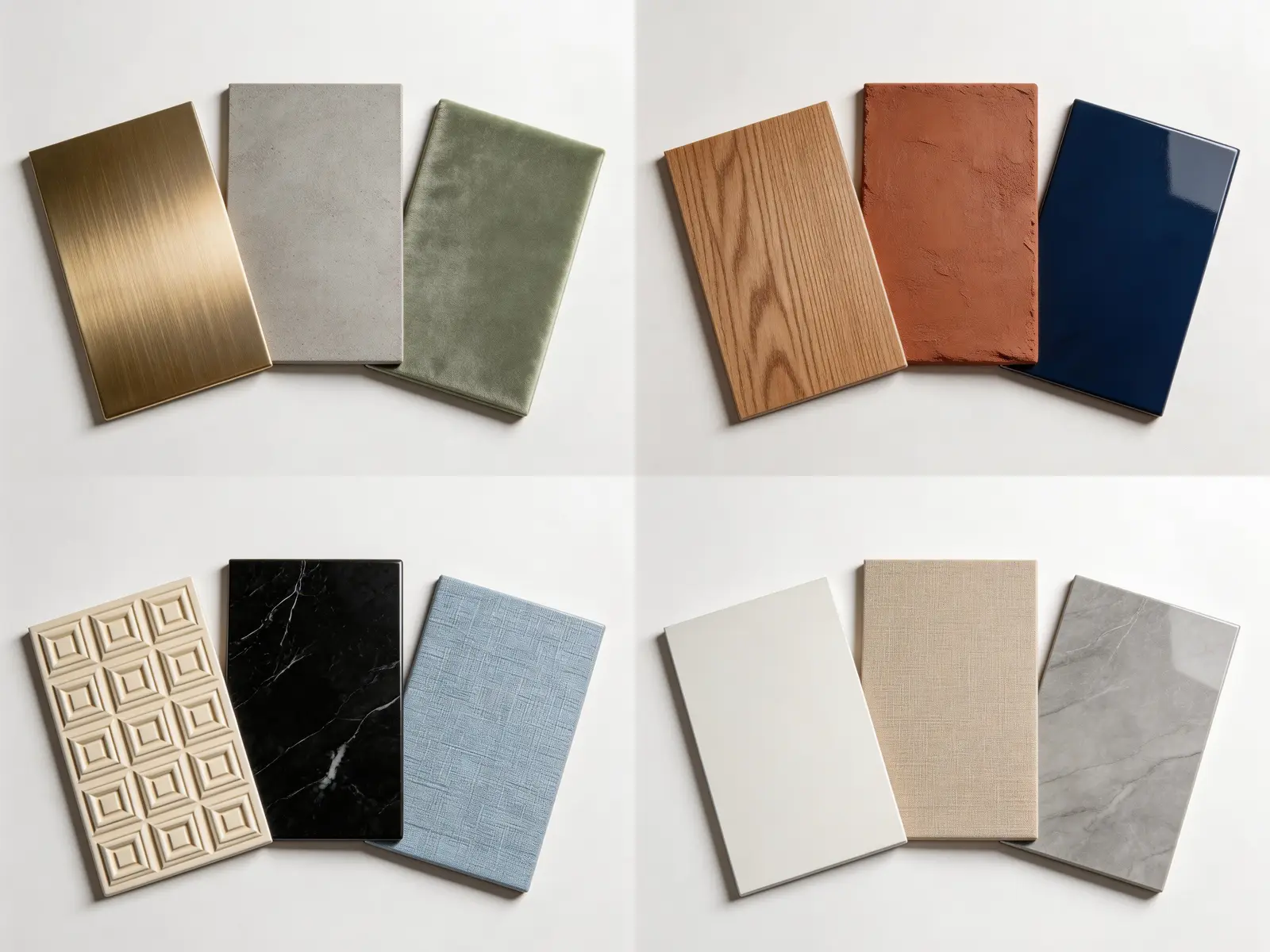
A customer points to a wood-look panel and says, “This one.” The next questions arrive quickly: How wide is it? What does the edge look like? Does the joint show? Which trim completes the corner? Is this exact colour available for the quantity required?
If the display answers only the first question—appearance—the salesperson still has to improvise the rest. A strong wall panel showroom display is therefore a small decision system, not a decorative collage.
Design the display around five buyer questions
1. Where can it be used?
Lead with an application image and a short boundary: interior wall, ceiling, dry feature area, flooring or exterior system. Do not let visually similar products blur into one category.
2. What does the real surface feel like?
Provide a touchable face sample large enough to show grain scale, print repeat, embossing and gloss. A small chip may hide the pattern rhythm.
3. How is it constructed?
Show a full cross-section, usable width and joining edge. Buyers and installers need to see what a front-facing board cannot explain.
4. How is the wall completed?
Place matching trims, corners, clips or adhesive guidance beside the panel. The completed detail usually creates more confidence than the face finish alone.
5. What happens next?
Give every sample a model code and a route to current specifications, catalog information or a quotation request. The customer should not have to photograph an unlabelled board and hope the team recognises it later.
A practical five-zone sample wall
| Zone | What to show | Decision it supports |
|---|---|---|
| Application | One honest room-context image and intended-use statement | Is this category relevant to my project? |
| Surface | Large face sample under realistic lighting | Do I like the colour, texture and gloss? |
| Profile | Cross-section, joint and effective coverage | What am I actually buying and installing? |
| System | Trims, corners and category-specific accessories | How will the finished edge or transition look? |
| Commercial | SKU, status, packing reference and inquiry route | Can this selection move into a current quote? |
Keep the main path visually quiet: a controlled core range at eye level, higher-impact designs in a secondary zone, and project-order finishes in a separate sample book or drawer. This makes the difference between stock, showroom extension and custom discussion visible to both the buyer and the sales team.
What every wall panel sample label should say
- Product category and model or finish code.
- Nominal size plus effective coverage where relevant.
- Short intended-use statement and a clear application boundary.
- Matching trim or accessory reference.
- Availability status: core sample, order-confirmed or project option.
- QR code or short link to the current catalog, specification request or quotation form.
- Version or review date so discontinued information can be removed.
A label is not a place for unverified superlatives. Claims such as fire performance, outdoor suitability or emissions compliance should point to evidence for the exact product and intended use, not appear as a category-wide promise.
Lighting can change the choice
Wood grain, marble film, metallic grooves and high-gloss surfaces can look different under warm LEDs, cool shop lighting and daylight. Include at least one neutral review area and avoid placing every sample directly under a dramatic spotlight. If two finishes are close, compare them side by side in the same position rather than across the room.
Photographs remain useful for follow-up, but record the model code in the same frame. A customer’s phone photo should help retrieve the sample; it should not become the colour-approval standard.
Build a sample-to-quote path
- Discover: record country, channel, room or project, substrate, installation route and approximate quantity.
- Shortlist: choose two or three relevant samples instead of sending an unfiltered gallery.
- Compare: review face, profile, joint, trims, lighting and application boundary.
- Identify: capture the exact model code and retain the approved physical sample.
- Confirm: obtain the current specification, packing, quantity, lead-time and availability information before presenting a final promise.
- Quote: connect the selected SKU to accessories and order details in writing.
Five display mistakes that slow down sales
- Showing only tiny colour chips: pattern scale, profile depth and joint appearance stay hidden.
- Mixing interior and exterior categories: similar colours can encourage the wrong application assumption.
- Leaving trims in a separate drawer: the buyer cannot imagine the completed edge.
- Using outdated codes: the showroom creates an inquiry the quotation team cannot trace.
- Letting the image overpromise: a room rendering should be marked as context, not presented as proof of an installed project or tested performance.
Weekly showroom maintenance checklist
- Remove damaged, faded or discontinued samples.
- Check that model codes still match the current commercial list.
- Return loose profiles and trims to the correct product group.
- Test QR and PDF links on a phone.
- Record which samples produced inquiries, sample requests or quotes.
- Promote proven fast-moving finishes and move low-interest options into the project-order section.
Buyer FAQ
What should a wall panel showroom display include?
Include a room-context image, a touchable face sample, a full profile or joint section, the matching trim set, a clear product label and a direct route to the current specification or quotation.
How many wall panel colours should a showroom display?
Start with a controlled core range that the team can sample, explain and replenish. Keep additional finishes in a clearly marked project-order or catalog-only group.
Can a phone photo replace a physical sample?
No. It can support follow-up, but screen colour, lighting and image processing can hide texture, gloss, profile depth and joint details. Retain the approved physical sample.
Should prices appear on the sample wall?
Only if the team can maintain them reliably. For B2B and project products, a price tier or inquiry code can be safer than a fixed figure that ignores specification, quantity, packing and trade terms.