Luvie Industry · 2026-10-13
Do PVC wall panels need expansion gaps?
A wall elevation may show a continuous decorative finish, yet the installer still needs an approved way to accommodate movement at its edges. For a distributor serving a sunlit South American shop or an air-conditioned Gulf interior, buying the panels without coordinating the trims leaves an important question unanswered. This guide explains what to request before quoting a complete wall-panel system; it is not a substitute for the selected model’s installation instructions.
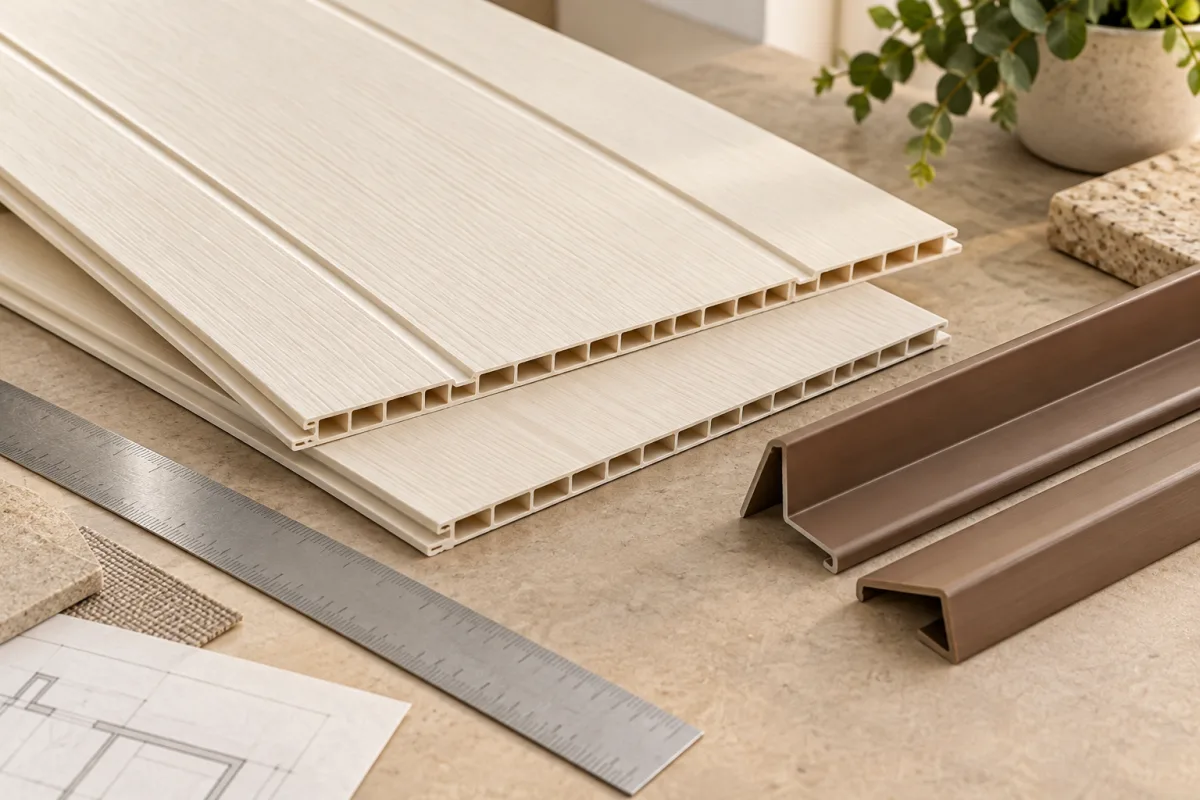
Use the movement allowances specified for the exact panel and installation system. Do not assume every PVC wall panel takes the same gap, or that a cover trim removes the need for one. Obtain a coordinated panel, fixing and edge-detail drawing before cutting.
Why one gap dimension cannot cover every PVC panel
Dumawall XL’s installation guide explicitly provides for expansion and contraction as temperatures change. That is evidence that movement needs a product-specific detail, not permission to reuse its dimensions for a Luvie model. Identify the panel reference, installed direction, length of each wall run and proposed support. Describe the expected room conditions, including periods before air conditioning starts and any direct sun. A location described only as indoors is not a complete exposure brief. Ask the supplier or project designer which instructions apply and record their revision. Do not derive a gap from a generic material label or an online photograph.
Separate panel joints, perimeter allowances and building joints
Three lines on a drawing can represent different things: a joint between decorative panels, space at a perimeter, and a movement joint in the underlying building. Ask the designer to identify each one instead of treating them as interchangeable. Submit corners, doors, wall ends and changes of substrate for review. An apparently continuous surface should not conceal an unresolved movement detail. If a building joint crosses the proposed cladding, obtain the project team’s detail for that location rather than bridging it on aesthetic grounds. Wet-area or fire-rated assemblies also need their applicable sealing and continuity requirements reviewed separately.
Check the trim and fixing together, not just the visible width
A trim can cover an edge without proving that the panel can move as intended. Ask for a section drawing showing the selected panel, trim, support and fixing arrangement. Have the installer confirm how the detail is assembled and whether adhesive, fasteners or finishing material would restrain the planned movement. Compare actual samples of the panel and trim rather than approving nominal thickness alone. For a mixed order, make a component list by model and room; similar-looking profiles should not be silently substituted. The person accepting the appearance should see the finished joint, while the technical team separately approves its function.
Turn the approved detail into an ordering and handover check
Before release, record the wall layout, product references, instruction revision, approved edge details and unresolved exceptions. Confirm which party supplies each accessory and which party checks site conditions. Can silicone replace a gap? Only the approved system detail can answer that; a sealant name alone is not a movement design. Can the installer trim every panel to the room size immediately on delivery? Cutting should follow the selected product’s preparation and installation requirements, not a universal waiting period. If conditions or components change, reopen the detail before proceeding. Keep a photographed first installation and written acceptance for the remaining rooms.
Next step
Send your wall layout, intended room conditions and panel reference to discuss compatible trims and the current installation information. Select the finish in the catalog, then approve the complete detail before placing the system order.