Luvie Industry · 2026-10-13
How should buyers approve the grain direction of decorative wall sheets?
Two sheets can share a colour reference and still look different when one is rotated. A buyer choosing marble-look UV sheets or a wood-effect decorative finish needs to approve more than a small swatch. The important question is how the selected faces work together across the actual wall. This is especially useful for distributors supplying feature walls, showroom displays and hotel reception areas, where an unexpected seam is highly visible.
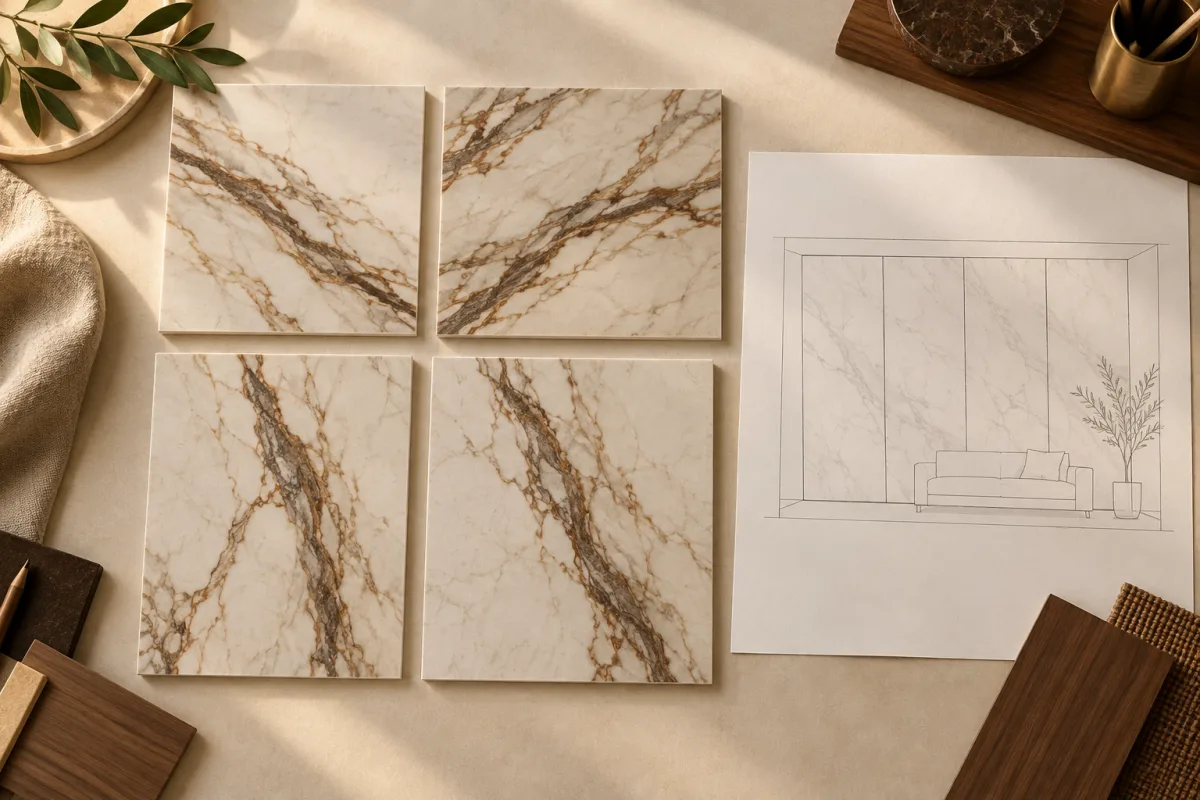
Approve a labelled sheet-by-sheet elevation using representative full-face information and, where practical, a physical mock-up. Confirm permitted orientation, pattern repeat and any matched-face availability. A matching colour code does not promise a continuous or mirrored pattern.
Ask about print direction and surface texture separately
A printed grain and a textured surface are two separate features to check. Formica’s texture guide distinguishes directional textures within its own laminate range; it is a useful reminder to ask the question, not evidence that a Luvie sheet has the same construction. Request the exact finish code, a full-face image, any direction marks and an explanation of how the pattern repeats. A cropped online swatch cannot show the relationship between opposite sheet edges. View the proposed orientation under the project lighting and record whether protective film remains on the sample. Keep the approved reference available to both sales and installation teams.
Define matching before using words such as seamless or bookmatched
Continuous veining and a mirrored bookmatch are different visual results. Ask the supplier whether the selected range actually offers coordinated faces and how those faces are identified. Do not promise either result by rotating two ordinary sheets in a presentation. Agree which seam is the focal point and what variation is acceptable at other joints. If the available product is a repeating decorative print, describe it that way. A digital mock-up communicates the intended arrangement but does not prove that the delivered sheets will reproduce it. Obtain confirmation against the supplied face references before selling a specific matched layout.
Make a cut map before turning wall area into an order
Draw each wall with its corners, openings and visible seams, then number the proposed pieces and mark their orientation. Allocate pieces to the available sheet faces before calculating quantities. A usable offcut for one wall may be unsuitable for another if its direction or pattern position conflicts with the layout. Do not deduct every door opening from the purchase quantity without checking how the surrounding pieces will be cut. Reserve replacement material according to the approved project plan rather than an invented universal waste percentage. Keep trim, movement and installation requirements visible on the same drawing; visual alignment cannot override those requirements.
Use a clear approval record when cartons reach the installer
Record the finish reference, face sequence if supplied, orientation, seam positions, approved mock-up and person accepting the appearance. Photograph the proposed arrangement before permanent fixing where the product’s handling instructions permit. Can a mismatched piece simply be turned upside down? Check the printed and textured direction and the approved layout first. Does ordering the same batch guarantee vein continuity? No such result should be assumed without an explicit matching specification. If delivered faces differ from the approved arrangement, stop cutting the affected pieces and ask for a revised layout. A written decision is more useful than an undocumented phone approval.
Next step
Share the wall elevation and the visual result you want, not just a colour name. Use the catalog to shortlist finishes and ask for current full-face references before approving the order.